Nation-leading data center bills progress through State Legislature
Earlier this week, two data center bills authored by Senator Steve Padilla, SB 886 and SB 887, advanced out of their policy committees.
Together, the bills form a nation-leading clean and affordable data centers framework that a) establishes baseline protections to ensure residential ratepayers are not paying for the state's data center build-out; while b) creating incentives for high-quality data center projects that meet various clean energy, community, and labor standards.
In this short update, we briefly revisit the bills before summarizing recent federal developments, including the Ratepayer Protection Pledge adopted by multiple technology companies at the White House in March. We highlight next steps as SB 886 and SB 887 now head to Senate Appropriations.
The goal: clean and affordable data centers
Evidence continues to mount regarding the impacts of unregulated data center expansion on consumers and the environment. These effects in states such as Virginia and the PJM region are already well documented. In a new report, the Union of Concerned Scientists now forecast similarly negative impacts in Louisiana, including up to $26 billion in new electricity system upgrades that would be charged to ratepayers. Powering these data centers with gas-fired generation could add another $3 billion in public health costs.
As the data center expansion moves west, California ratepayers are increasingly exposed to these same risks. California is already ranked third in the nation for data center capacity, and the CEC forecasts 5 GW of new data center load by 2035.
SB 886 aims to get ahead of these issues by establishing a base set of protections for ratepayers, including that data centers should: (i) pay for their own grid connection costs; (ii) bring their own clean energy and participate in demand-response programs; and (iii) face a termination fee in the event they cease operations early. These base protections are aligned with multiple studies and research reports, including from Harvard, MIT, Princeton, Duke (here and here), Little Hoover Commission, Union of Concerned Scientists, Natural Resources Defense Council, and many others.
With these base protections in place, the state can turn towards incentivizing high-quality data center projects and capitalizing on the the economic and innovation opportunities presented by the AI boom. SB 887 provides CEQA streamlining to eligible data center projects. Although there is some overlap with requirements in SB 886, such as requiring the use of clean energy, SB 887 overall requires meeting a higher threshold, including by meeting various labor, environmental, and community standards.
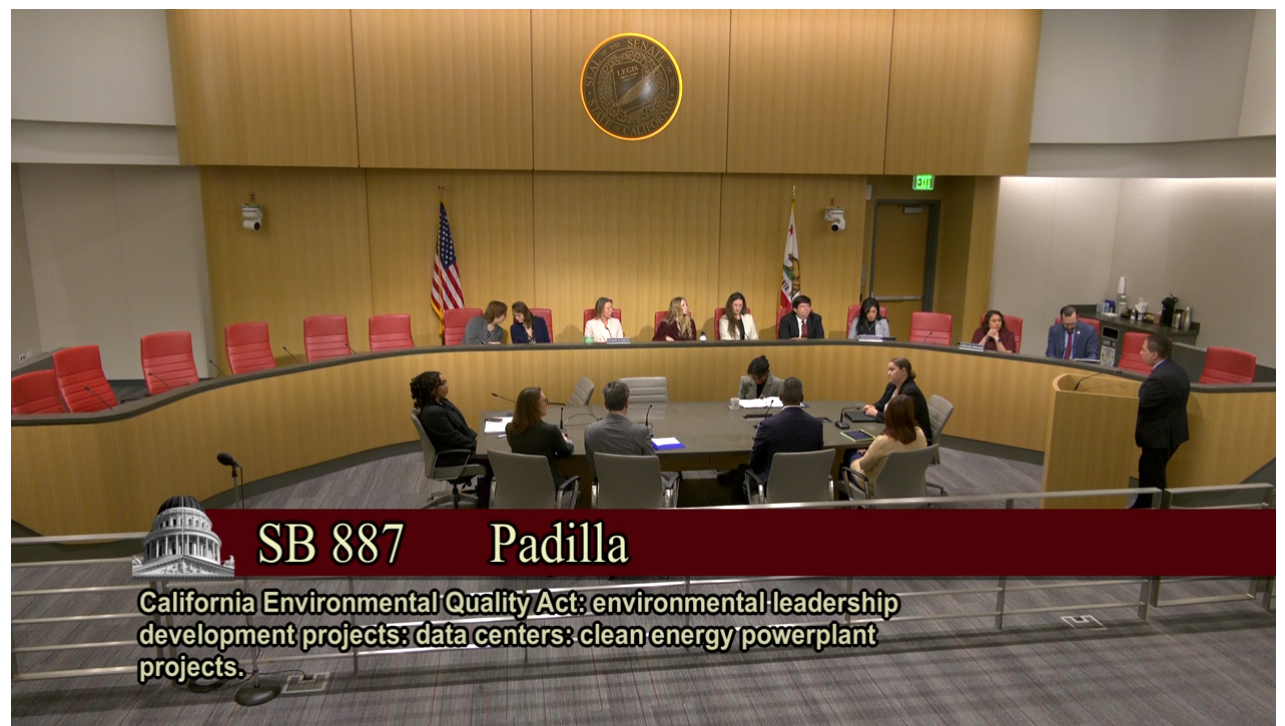
The below video provides a snapshot of key discussion related to one of the bills, SB 887:
Federal policy: Ratepayer Protection Pledge
Both SB 886 and SB 887 strong support from legislators throughout their policy committees as a pragmatic package that aims to balance multiple objectives including energy affordability and reliability, economic development, labor and community benefits, and environmental protection.
This approach seems to be supported at the federal level, when in March multiple technology companies met with President Trump to sign the Ratepayer Protection Pledge to "protect American consumers from price hikes, due to data center energy and infrastructure requirements, and lower electricity costs for consumers in the long-term. Table 1 summarizes the five pillars of pledge.
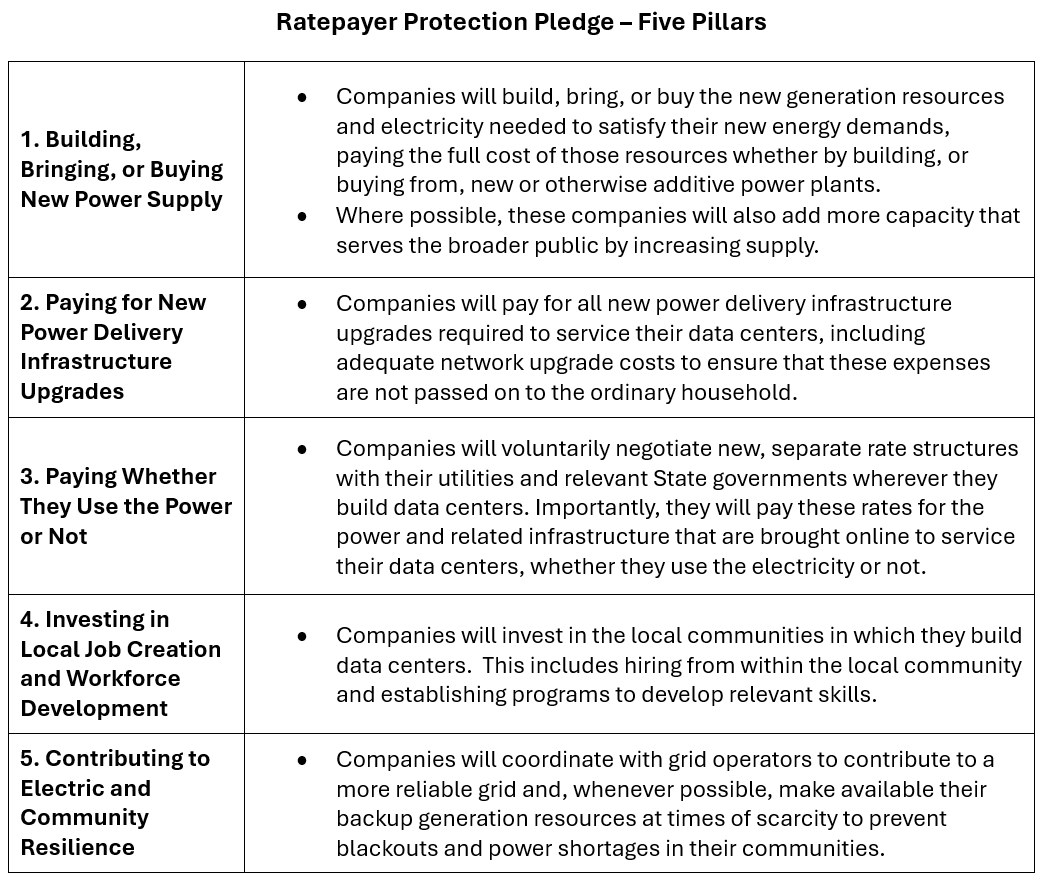
Table 1: Summary of the Ratepayer Protection Pledge. Source: White House
In reviewing the five pillars, it is notable that they demonstrated a significant – almost completely identical – overlap with the policies in SB 886 and SB 887.
Specifically, pillars #1, #2, #3, and #5 map directly with provisions in section 8542 of SB 886, which requires that data centers pay for their grid connection costs, procure clean energy, contribute to grid resilience (i.e. demand response), and pay whether they use the power or not (termination fee). Pillar #4 maps directly with SB 887 and goals related to community benefits. Arguably the pledge goes further than SB 886 and 887 via pillar #1 – and the possibility of adding more grid capacity for public benefit.
However, at this stage it is notable that the Data Center Coalition – an advocacy organization that represents pledge signatories including Amazon, Google, and Microsoft – currently oppose both SB 886 and SB 887. Further work is needed to understand the reasoning behind their concerns given it would appear that these bills achieve their stated goals in the Ratepayer Protection Pledge.
Senate Appropriations and next steps
Both SB 886 and SB 887 now move to Senate Appropriations, where they will be evaluated based upon their fiscal impact. This will occur in early May. If the bills are passed out of Senate Appropriations, they will then be voted on the Senate Floor in late May.
For more information, please contact Sam Uden (sam@netzerocalifornia.org).