Big wins, notable losses in turbulent end to California’s legislative session
For the second consecutive year, California leaders advanced multiple reforms that marry ambitious climate action with energy affordability.
Data centers was the most significant in this respect, with SB 886 (Padilla) and AB 2383 (Zbur) combining to establish a new large-load tariff structure at the CPUC. One of the most rigorous policies of its kind in the nation, it requires data centers pay for their own energy generation and grid upgrades and prevents cost-shifts to ratepayers. SB 887 (Padilla) complemented this package by providing a permitting incentive for data centers that meet additional environmental, labor, and community standards.
Multiple other grid and energy affordability policies also progressed, including: requirements for the CPUC to collect grid utilization data (SB 905, Becker); accountability measures to reduce delays in the transmission development process (AB 2493, Petrie-Norris); transparency measures related to utility cost-of-capital proceedings (AB 2463, Petrie-Norris); and $325M and 10 staff positions to launch the Transmission Infrastructure Accelerator.
A final key climate bill was AB 1666 (Rogers), which would address California’s wood waste crisis by establishing new biomass innovation parks. For an issue where progress has proven notoriously challenging, AB 1666 was supported by an extensive coalition, passing unanimously in both houses (78-0; 40-0) on its way to the Governor’s desk.
Unfortunately, the legislative session fell short of its potential, with a number of key policies failing to advance.
The collapse of wildfire negotiations, which dominated the final weeks of session, was the most significant setback. The debate centered on a proposal to reallocate the costs of wildfires from primarily utilities and their ratepayers to a broader pool of stakeholders, notably insurers. As talks unraveled, multiple policies tied to the package fell over, including a proposed new multi-billion-dollar fund to support wildfire mitigation. Given the scale of the state’s wildfire mitigation need, this was a significant missed opportunity. Importantly, several other wildfire bills advanced independently out of the Legislature that lay groundwork for mitigation project implementation should funding become available, including: SB 894 (Allen), AB 1960 (Bennett), SB 973 (Becker), and AB 1699 (Rogers).
Other notable energy policies fell short earlier in the session. AB 2672 (Hart) and SB 1245 (Stern), which would have supported a steady fuels transition by providing greater flexibility around gasoline requirements, failed to advance following strong opposition from the oil industry. AB 2516 (Petrie-Norris), which would have enabled centralized procurement of electric grid components, also failed to advance.
Overall, policymakers made important progress again this year, with the data center package meeting the moment as states across the country struggle to find a credible path forward. Had broader wildfire reforms also landed, the session would have been exceptionally productive. Below, we unpack this year’s legislative and regulatory developments in more detail before offering some early considerations for the next Governor on actions needed to keep California’s climate goals within reach.
Key legislative developments
In this section, we look at policy outcomes across five main issue areas: (i) data centers; (ii) grid and energy affordability; (iii) sustainable bioeconomy; (iv) wildfire; and (v) fuels transition. We provide further context on data centers and wildfire as the two main negotiated issues this session.
Data centers
Data center-driven load growth has emerged as the most consequential energy issue nationally. In Virginia and across parts of the Northeast and Midwest, rapid development has already added billions in costs to ratepayers, driven by new grid infrastructure and higher wholesale electricity prices. In PJM, capacity prices have increased by more than 400%, with FERC Chair Laura Swett describing the surge in demand as carrying the potential for “historically unprecedented catastrophic failure.” California utilities have reported a staggering 23 GW in capacity requests, while the CEC has filtered these into a forecast that the grid would need to accommodate up to 8 GW of new data center demand by 2035 (Figure 1).
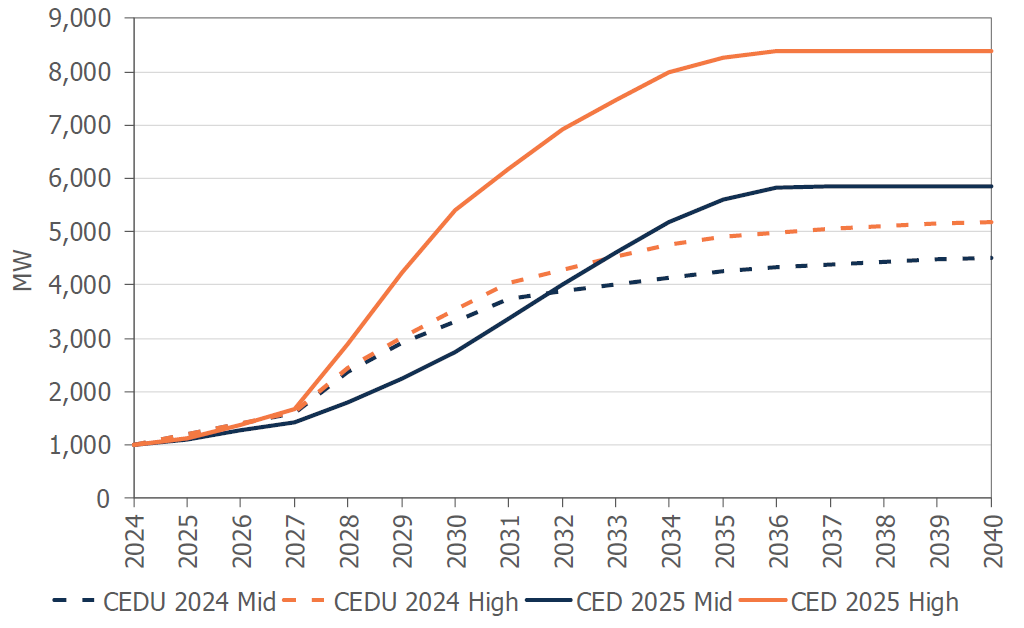
Figure 1: This diagram shows alternate scenarios of data center demand out to 2040. For context, California's peak demand is roughly 50 GW and has been generally flat for the past decade. The High Scenario would amount to a 15% increase in peak demand. Source: CEC IEPR (2025)
With political opposition growing – for example, New York recently imposed the nation’s first statewide moratorium on new data centers of 50 MW or more, while a California poll found 70% of voters opposed unregulated data center expansion – the challenge has been finding a path that protects consumers and the grid without foregoing the technological and economic opportunities associated with data center development. SB 886 (Padilla) and AB 2383 (Zbur) form a two-bill package that achieves these goals in California. Despite strong opposition from the Data Center Coalition, the final package establishes one of the most rigorous large-load frameworks in the country, including:
No cost-shift standard: The package establishes a clear principle that the costs and risks created by large new data center loads should not be shifted onto existing customers.
Grid infrastructure: Data centers must pay for transmission and distribution upgrades associated with their interconnection and use of the grid.
Incremental generation: Data centers must cover the incremental generation costs needed to serve their load for at least 10 years, backed by upfront collateral or prepayment.
Protection against speculative load: Minimum payments and early-termination fees protect ratepayers when projected demand fails to materialize or projects exit early.
Broader system costs: Data centers must pay an appropriate share of broader electricity-system costs, including wildfire mitigation.
The bills establish these requirements in statute, with the implementation details to be developed through a CPUC proceeding.
One area that did weaken during negotiations was demand response. An earlier version of SB 886 required data centers to participate in load-shifting programs, but this provision was ultimately made voluntary. Although there is already some evidence (Duke, MIT), further research can help demonstrate the potential ratepayer and grid benefits of making large data center loads more flexible in California.
A third key data center bill is SB 887 (Padilla), which was designed to complement the ratepayer protection foundation by providing a CEQA incentive for projects that meet certain water-use, labor, and community benefit standards. By offering judicial streamlining in exchange for meeting these requirements, the bill further encourages higher-standard data center development in California. Both SB 886 and SB 887 were co-sponsored by The Utility Reform Network and Net-Zero California
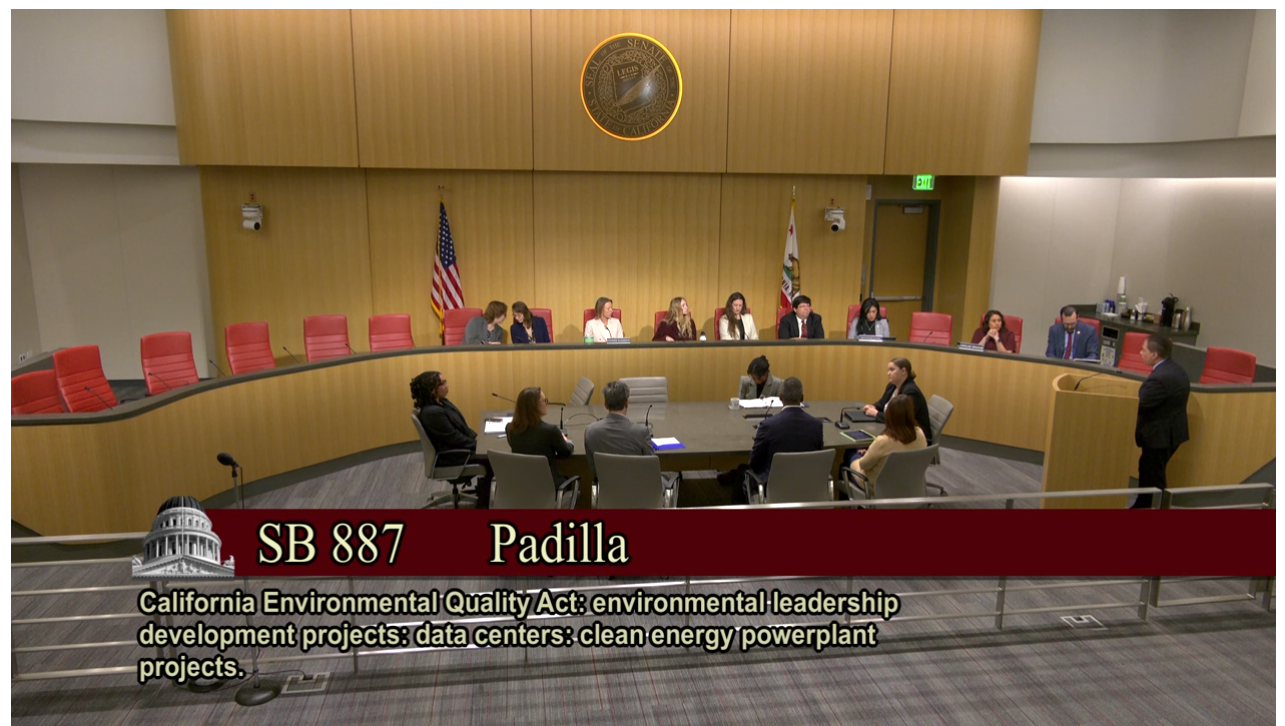
Figure 2: This clip shows Senator Padilla, author of SB 887, emphasizing the importance of strong ratepayer protections while providing a path to high standard data center development in California. Source: CalMatters
Grid and energy affordability
In 2025, California’s legislative session was defined by a major shift to deliver energy affordability in conjunction with climate action. This focus carried into 2026, with a number of targeted grid reforms sent to the Governor’s desk, including:
SB 905 (Becker): Requires utilities to publicly report on the degree to which their distribution grids are being utilized and assess whether load flexibility and storage can meet grid needs more cost-effectively than traditional upgrades.
AB 2493 (Petrie-Norris): Establishes a new transmission development monitor to track project timelines, identify avoidable delays, and trigger corrective action where needed.
AB 2463 (Petrie-Norris): Requires the CPUC to provide its own analysis when determining utility returns on equity and disclose the financial models, assumptions, weighting, and calculations underlying its decisions.
Transmission Infrastructure Accelerator: Provides $325 million in Proposition 4 funding and 10 staff positions at state agencies to launch the Transmission Infrastructure Accelerator established through SB 254 (Becker, Petrie-Norris) in 2025, alongside various clean-up measures. A portion of Cap-and-Invest proceeds will also begin flowing into the Revolving Fund to support public financing investments, with a statutory goal of maximizing ratepayer savings.
One notable grid reform did fall short, with AB 2516 (Petrie-Norris) failing to advance out of Senate Appropriations:
AB 2516 (Petrie-Norris): Would have established the California Grid Manufacturing Initiative to assess statewide needs for critical grid components, support coordinated procurement, and expand in-state manufacturing. Given research identifying significant potential ratepayer savings from reducing grid-component costs, the proposal may be worth revisiting in a future session.
Overall, these policies represent meaningful progress toward improving speed to power and modernizing California’s grid. Reducing delays ought to be one key focus area, with a 10-year development timeline for essential transmission completely misaligned with the state's clean energy goals (Figure 3). Further below, we identify several other near-term power sector priorities that build upon the above reforms.
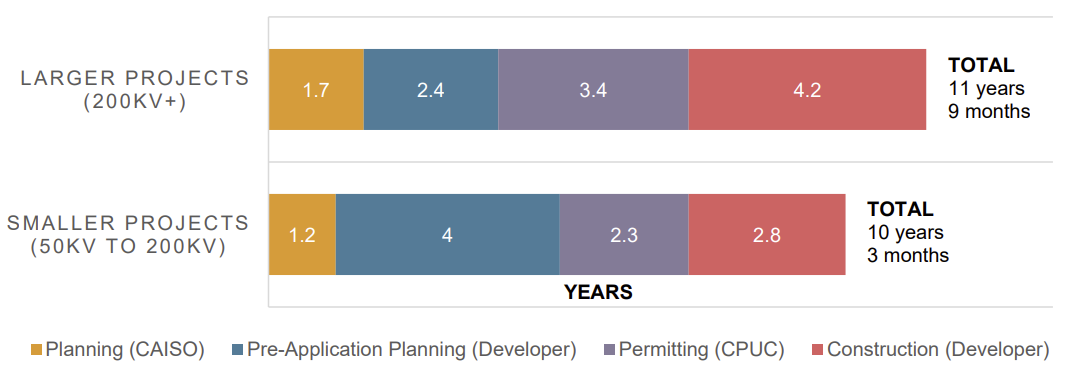
Figure 3: This diagram shows just how long it takes to build transmission in California. The state should expect to fall short of its goals if it cannot drastically compress these lead times. Source: CPUC Advocates Office (2023)
Sustainable bioeconomy
California's wood waste crisis remains one of the most severely neglected issues in California climate policy. Millions of tons of forest and agricultural biomass are piled and burned or left to decay each year, causing significant carbon and air pollution. Yet this challenge also presents an opportunity: developing a sustainable bioeconomy that converts these residues into low-carbon products can avoid these impacts while creating high-road jobs, accelerating technology innovation, and supporting wildfire risk reduction.
Although this vision is straightforward, making tangible progress has proven extremely difficult. This is in large part because biomass utilization has relied heavily on large-scale combustion, which has been identified as costly (CEC, CPUC) and polluting (CARB), while emerging alternatives face barriers around infrastructure, feedstock supply, and market demand. AB 1666 (Rogers) was deliberately crafted to navigate these challenges: focusing on non-combustion technologies, aligning with existing state policies including the 2022 Scoping Plan, SB 254 Report, and Jobs First program, and ensuring robust guardrails. The result was a first-of-its-kind support coalition including environmental groups, local and regional economic development organizations, air pollution control districts, a Tribal government, and biomass technology developers. Specifically, the bill would accomplish the following:
Biomass Innovation Parks: Directs CNRA to establish one or more Biomass Innovation Parks as regional hubs that bring together public and private entities to commercialize and scale non-combustion biomass technologies, including mass timber, low-carbon fuels, and biomass carbon removal.
Grants and financing program: Establishes a dedicated grants and financing program at CNRA to support development of the parks.
Regional wood waste assessments: Directs CNRA, with LCI and CAL FIRE, to assess the availability and characteristics of wood waste across different regions, providing greater certainty around the feedstock available to support new projects.
Biomass tracking: Directs CNRA, with LCI and CAL FIRE, to establish a system to trace and authenticate the origins of forest biomass, providing guardrails to ensure the sustainability of supply.
Long-term feedstock supply: Directs CNRA, with LCI and CAL FIRE, to support efforts to facilitate and aggregate longer-term biomass supply across federal and non-industrial private lands. Reliable supply is critical to reducing development risk, as uncertainty around future feedstock remains a significant obstacle to financing new facilities.
While AB 1666 would address two of the three key barriers to scaling California’s bioeconomy – infrastructure and feedstock supply – the missing piece is market demand. Previous iterations of the bill included policies to support state procurement of wood products and develop carbon-based incentives – but these provisions were unfortunately stripped out during the legislative process. Future efforts should revisit these policies and establish durable demand for non-combustion products and end-uses. This policy gap was well articulated in a support letter submitted by the California Mass Timber Coalition to the Administration. AB 1666 was sponsored by Net-Zero California.
Wildfire
Wildfire reform dominated the final weeks of the legislative session, reopening one of the most difficult questions in California energy policy: who should pay for the costs of catastrophic wildfires? The answer has billion-dollar implications for utilities, insurers and reinsurers, wildfire survivors, consumer attorneys, hedge funds, local governments, and more.
Following the release of the SB 254 report in April, the Administration moved first with a term sheet focused primarily on reallocating wildfire costs, including notably via eliminating insurer subrogation and placing a $6B per event cap on the Wildfire Fund. The Assembly and Senate responded with their own proposals, and fault lines quickly emerged over how much additional risk should be shifted from utilities to insurers. A middle path appeared possible in the final days, with discussions of a phased approach to reducing subrogation – but negotiations ultimately ran out of time. Figure 4 details a narrow compromise that was proposed in SB 492, which fell well short of any meaningful structural reforms to address the overexposure of utilities and their ratepayers to wildfire costs. Ultimately, the Legislature did not take up the bill on the floor, with calls to revisit the issue next year (or, possibly, in a special session).
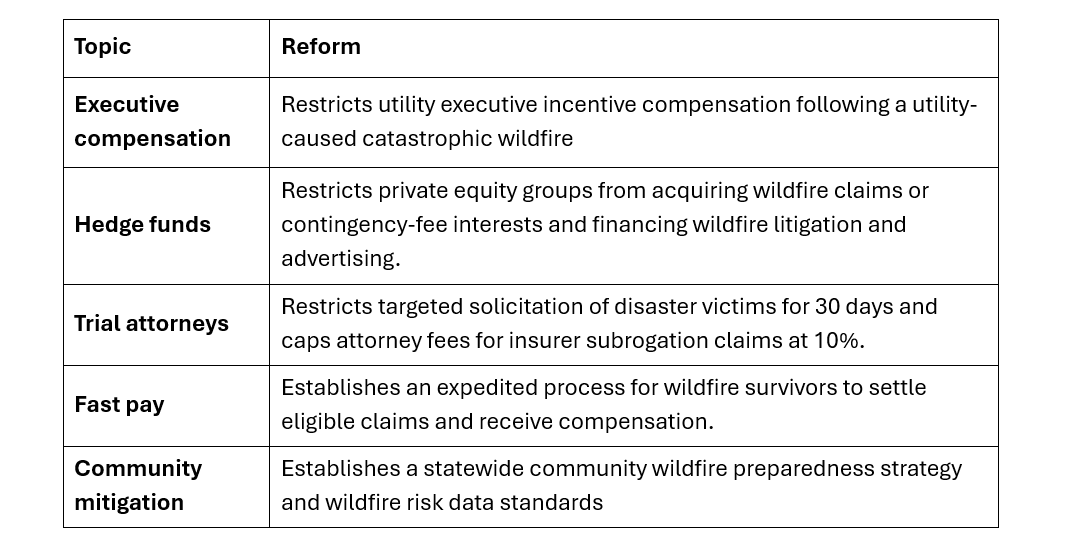
Figure 4: This table summarizes the narrow package that was ultimately rejected by the Assembly.
A crucial – and seemingly underappreciated – point is that the negotiation focused primarily on how to reallocate wildfire costs. While important, changing who pays does nothing to reduce the likelihood of the next wildfire occurring, or the damage it could cause. This requires wildfire mitigation.
It is difficult to overstate just how much of a hole California is in in regard to wildfire mitigation. The SB 254 report identified a need for $4–7 billion in annual investment. In contrast, the state spends roughly $500 million annually today – an extraordinary gap given our intimate experience with catastrophic wildfires. The Assembly proposal (p. 11) identified establishing a new centralized mitigation fund that could pool contributions from utilities, insurers, and potentially other public and private sources and direct this capital towards highest-priority mitigation projects (Figure 5). Importantly, the broader wildfire cost negotiations created a rare opportunity to drive early-stage capitalization of the fund – potentially allowing California to make more progress on wildfire mitigation in a single package than it has in a decade. The loss of this opportunity was perhaps the biggest casualty from the failed negotiations. It remains unclear how else the state can mobilize billions in annual funding for wildfire mitigation.
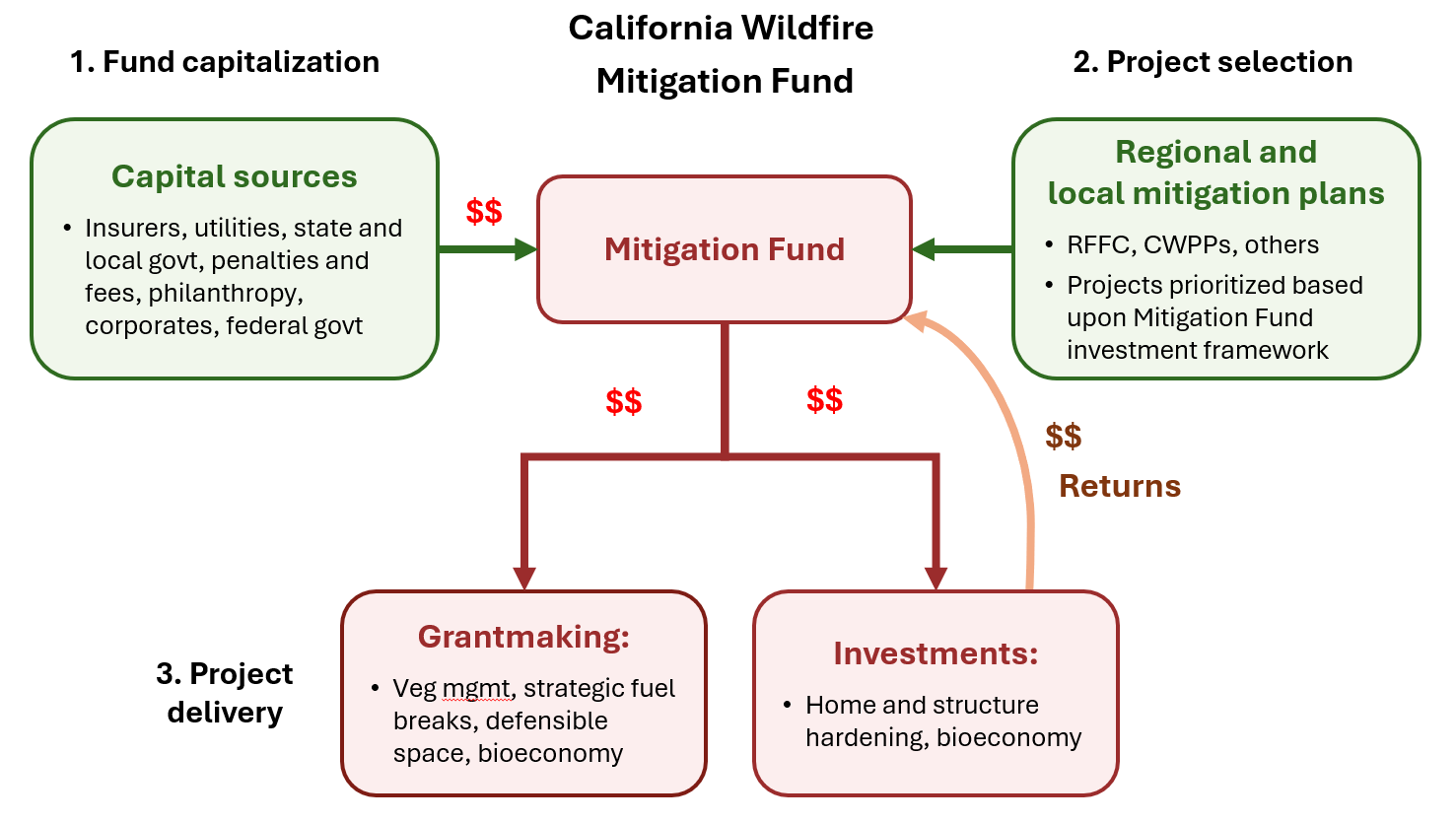
Figure 5: This diagram shows a basic structuring of a potential centralized mitigation fund. For more information, see: Will the Legislature take action on wildfire mitigation?
There are no easy solutions to California’s wildfire crisis, and any structural reform will involve difficult tradeoffs. But the status quo is completely untenable – something acknowledged by stakeholders on all sides of the debate. As state leaders look to revisit this issue, they might consider a broader array of liability reforms, including liability backstop options contemplated in Strategy 3.1 of the SB 254 Report. A centralized fund for mitigation should be a leading priority of any wildfire reform proposal.
Fortunately, several key wildfire bills progressed independently of the collapsed package, advancing targeted reforms on issues including home hardening (SB 894, Allen; AB 1960, Bennett), county-level coordination (SB 973, Becker), and beneficial fire (AB 1699, Rogers). Taken together, these bills address several of the practical barriers to implementing mitigation projects in California. This groundwork will become crucial if California succeeds in unlocking the large-scale funding needed for wildfire mitigation.
Fuels transition
California’s transition away from gasoline presents a difficult near-term challenge: gasoline demand is declining, but millions of Californians will continue to depend on the fuel as the state’s refining sector contracts. Maintaining an affordable and reliable supply through this transition will therefore require policies that increase market flexibility without undermining California’s climate and air quality goals.
One promising approach would allow alternative-specification gasoline to be sold in California during periods of constrained supply. California’s unique CARBOB gasoline blend is produced by a limited number of suppliers, leaving the state exposed to price spikes when refinery outages or other disruptions occur. The CEC proposed allowing sellers to bring in more widely available gasoline subject to a fee, while in a related analysis, the Union of Concerned Scientists found that directing the resulting revenue toward replacing older, higher-polluting vehicles could offset the associated emissions impacts.
Two bills sought to advance versions of this approach in 2026. AB 2672 (Hart) would have expanded California’s existing gasoline variance process to facilitate the use of alternative-specification gasoline during supply constraints, with associated revenues supporting replacement of older vehicles. SB 1245 (Stern) would have required the CEC and CARB to implement a strategy to facilitate alternative-specification gasoline if their analysis found it would improve affordability and reliability. In a detailed analysis, bill sponsor UCS identifies the strong oil industry opposition that ultimately killed the bills.
Ultimately, this remains a sound policy approach that should benefit from the work undertaken this year, providing a strong foundation to revisit the legislation in 2027.
Key regulatory developments
Although the legislative session recently concluded, several other important climate and energy policies are also progressing through regulatory and planning processes. Below, we provide a short update on three developments this year: Cap-and-Invest (CARB); Transportation Fuels Transition (CEC); and SB 905 Carbon Capture, Removal, and Sequestration (CARB):
Cap-and-Invest: CARB approved major amendments to the state’s Cap-and-Invest program in May, following its extension through 2045 last year (AB 1207, Irwin). The regulations tighten future allowance budgets and make a range of changes to allowance allocation, cost containment, and market rules. Most notably, they establish a new Manufacturing Decarbonization Incentive (MDI) program, which could make up to 118 million allowances available to support industrial decarbonization projects. Although the MDI proved controversial given its potential to reduce GGRF revenues, multiple analyses show that GGRF programs have been severely underperforming on climate outcomes for over a decade. Initial market signals following new rule adoption have been positive: the first quarterly auction cleared at $32.48, up 12.7% from May, following CARB analysis that clarified rules related to MDI implementation (see: Elevate Climate).
Transportation Fuels Transition: The CEC released its draft Transportation Fuels Transition Plan in May, examining how California can maintain affordable and reliable fuel supplies as petroleum demand declines and refineries close. The plan provides analysis of potential refinery contraction through 2045, growing reliance on fuel imports, infrastructure needs, and impacts on communities, while identifying a number of near-term strategies. However, while the report recognizes the need for long-term planning, it stops short of establishing a clear path for how California should manage the orderly contraction of its refining sector over the coming decades. Developing such a strategy will become increasingly important as the fuels transition progresses.
SB 905: CARB is in the early stages of developing regulations to implement SB 905 (Caballero), which established a framework for carbon capture, removal, and storage projects in California. In May, CARB released its first regulatory concepts covering issues including project definitions, monitoring and reporting, financial responsibility, and potential protocols for additional carbon removal and utilization pathways, followed by a public workshop in June. The framework remains in pre-rulemaking, with CARB seeking stakeholder feedback as it works through the technical, environmental, and implementation questions associated with scaling these technologies.
Early considerations for the next Governor
In the final two years of the Newsom Administration, there has been a clear recognition that climate ambition alone is not enough. Progress increasingly depends on addressing implementation barriers – from project financing and permitting to the broader challenge of energy affordability. This more pragmatic approach should provide a foundation for the next phase of California climate policy.
The next Administration will take over at this mid-transition moment. Some issues will require immediate attention – notably wildfire reform. Others will require building upon recent progress, especially in the power sector. Deploying the state’s new Transmission Infrastructure Accelerator, further reducing transmission development lead times, implementing the new data center framework, and examining whether more can be done to reform utility incentives are all key opportunities.
But there are also areas where California remains well off the pace. Two stand out: refineries and carbon management. The CEC has done an excellent job identifying near-term strategies to manage gasoline supply, but California still needs a long-term strategy for managing the refining sector’s contraction. Carbon management faces a different challenge: the 2022 Scoping Plan envisions roughly 100 Mt/yr of carbon capture and removal by 2045. Building an industry of that scale from (effectively) scratch will require orders of magnitude more policy support and public investment than exists today.
Can California achieve its 2030 climate goal?
Finally, the next Governor will have to reckon with a broader challenge: the risk that California falls short of its 2030 climate goal. Statewide emissions fell by 71 million metric tons between 2014 and 2023, or about 8 million tons annually. Reaching the 2030 target would require reductions of roughly 14 to 19 million tons annually through the end of the decade (the range depends on whether the 2030 goal is 40% (statutory), or 48% (Scoping Plan), emissions reductions). Put simply, California needs to double its pace of emissions reductions – at a time when the state is facing growing cost-of-living pressures, gasoline price spikes, worsening wildfire risk, and a void of federal support.
Other states have responded to similar pressures by retreating from their climate targets. Not only would this undermine the clean economy opportunity California has been driving through its climate goals, it would also forgo a global leadership opportunity to reimagine climate policy for the mid-transition. This includes a more adaptive approach, whereby emissions targets are paired with technology and infrastructure deployment goals; targeted and potentially time-limited interventions – such as permitting reforms or tax incentives – are used to accelerate deployment in sectors falling behind; and policies are adjusted or temporarily relaxed where costs or implementation barriers become acute.
The 2027 Scoping Plan provides an early opportunity to begin developing this approach – maintaining California’s long-term ambition while becoming more flexible and opportunistic about how it gets there.
Conclusion
Overall, the 2026 legislative session delivered meaningful progress. California established nation-leading data center standards, advanced targeted reforms to improve the grid and energy affordability, and took a major step toward building a sustainable bioeconomy. But the session also left key opportunities on the table. The collapse of wildfire negotiations left California without a credible path to mobilize the billions needed for mitigation, while promising efforts to better manage the fuels transition also fell short. The result was a productive, if incomplete, year.
The task now is to build on that progress as California enters a more difficult phase of its energy transition. Near-term priorities should include revisiting wildfire reform, building upon recent power sector reforms, and developing longer-term strategies for refineries and carbon management. Confronting the growing risk of missing the state’s 2030 climate goal is also a key need. California must retain its climate ambition while becoming more pragmatic, adaptive, and opportunistic about how it achieves its goals.
***
T-minus 19 years to deliver a Net-Zero California